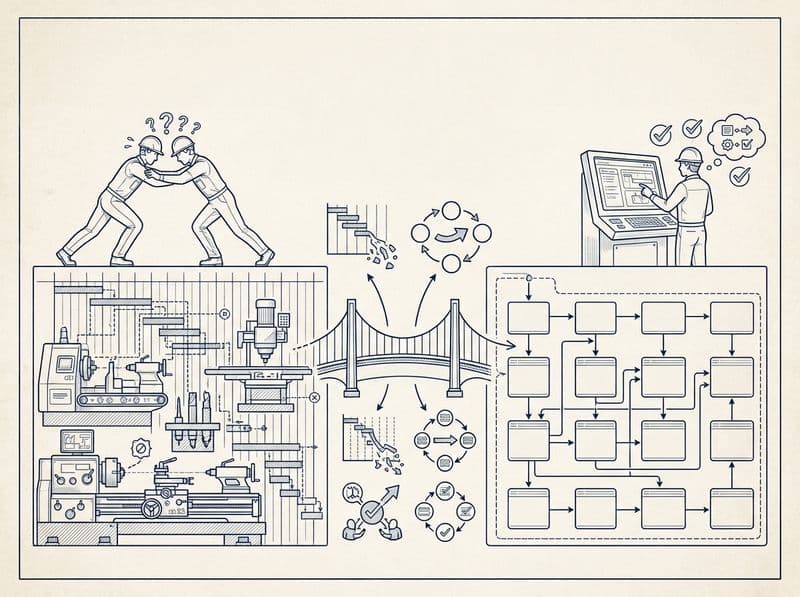
Imagine your 5-axis mill runs flat out all weekend, cutting hundreds of components with flawless precision. On Monday morning, you walk onto the floor expecting to ship a major order, only to find every single part sitting in bins beside the assembly bench because nobody scheduled the staff needed to install heated inserts. Your expensive machine was technically fully utilized, but all you really did was pump out a massive backlog of unfinished parts that nobody can ship. Why does this keep happening on shop floors? The core issue is that conventional scheduling tools treat the machine as the only thing that matters, ignoring all the human and physical bottlenecks that determine when jobs actually leave the building.
When most people imagine manufacturing software, they picture a tidy Gantt chart showing that a specific part runs on a specific machine at ten in the morning and finishes by noon. On paper, that sounds like a noble goal, and if your facility could hit those timestamps reliably, your business would run like clockwork. But if you spend any real time walking shop floors, you quickly realize that almost every Gantt chart is fundamentally inaccurate within hours of being printed. The software treats the schedule as both the means and the end, relying on data that is simply too poor in quality to reflect what is actually happening in front of you.
The spindle utilisation trap
The single biggest trap shop owners fall into is scheduling the machine rather than scheduling the work. It is completely natural that people think this way at first, especially after you've invested millions of dollars into high-end CNC machines and want to see maximum equipment utilization on your balance sheet. But running a spindle at 100% capacity doesn't mean anything if the jobs coming off the table immediately hit a wall. Machine time is only a fraction of the actual equation. A working schedule has to account for all of the unglamorous preparation and post-processing work happening around that spindle every single day.
What does that surrounding work actually look like in practice? Before a single tool touches metal, you need people to handle machine maintenance, prepare digital build files, sort through Design-for-Manufacturing checks, and ensure the right feedstock is staged and ready to load. And once the cutting is done, those parts still need wire cutting, ball milling, anodization, or manual assembly. If you only schedule the primary machine and treat everything else as an afterthought, your floor quickly devolves into chaos as unfinished inventory piles up between stations.
The failure of greedy scheduling
To manage this complexity, many facilities end up running what you'd call a greedy schedule - loading jobs into the software only an hour or two before a build starts. When you operate that way, you never build an accurate forecast of what your capacity looks like two or three months out. If a new customer calls asking for a delivery quote, you have no reliable way to tell them when their order will actually land on their dock, because you don't know what your true work in progress looks like.
Now, a skeptic might look at this and argue that planning three months in advance on a chaotic shop floor is pure fantasy. And in a sense, they're completely right. If you build a rigid three-month Gantt chart on Monday, a single scrapped part or a broken end mill on Tuesday morning will blow up the entire plan. But the answer to shop-floor volatility isn't to give up and schedule only one hour ahead; it's to run a dynamic schedule that automatically recalculates whenever reality intervenes. Thankfully, day-to-day variations in setup times and scrap rates naturally cluster around predictable averages, meaning your long-term plan stays remarkably stable even while you adjust to real-time events on the floor.
Clean data and operator incentives
So how do you actually feed a dynamic rescheduling engine with accurate, real-time data? This is where traditional software models completely fall apart on the shop floor. In a standard setup, an operator does thirty minutes of physical work at a machine, and then they're expected to walk across the room to a dusty terminal and type in what they just did. Naturally, nobody wants to do that. Traditional ERP systems are built as passive administrative databases where people do the work and then spend valuable time telling the computer about the work, which means the recorded data is either late, rushed, or flat-out wrong.
To fix this feedback loop, the software has to actively help the operator do their job rather than feeling like administrative overhead. At Phasio, we approached this by placing iPads directly at each workstation and running computer vision models that visually recognize parts as they move across the table. Instead of forcing an operator to memorize part numbers or dig through paperwork to figure out who an order belongs to, the camera identifies the component instantly and surfaces the relevant instructions. Because the tool actually removes mental strain from their day-to-day workflow, operators interact with the tablet naturally while they work.
What does that look like behind the scenes? Every time an operator interacts with the tablet, the system automatically captures perfect timestamps and visual records of the part at that exact workstation. You get effortless component traceability, so if a scratch appears later during anodization, you can check earlier station photos to see exactly where the defect happened. More importantly, your dynamic scheduling engine gets fed a continuous stream of accurate floor data without turning your machinists into data entry clerks. When the underlying data is trustworthy, the resulting schedule is trustworthy.
The boardroom disconnect
Why haven't legacy manufacturing software vendors built tools like this before? Fundamentally, it comes down to a massive cultural disconnect between corporate buyers and shop-floor reality. Software purchasing decisions are almost always made by IT directors or finance executives who sit in an ivory tower far away from the dirty realiy of the shop floor. They buy software based on feature checklists and compliance dashboards that look great in a boardroom presentation, completely ignoring how painful the interface is for the person standing at the CNC mill.
The people doing the physical work rarely control the software budget, but they hold complete veto power over whether the system succeeds. If a tool doesn't make their immediate job easier, they won't feed it clean data, and your scheduling engine collapses into garbage. If enterprise vendors keep building for the boardroom buyer instead of the operator at the mill, can automated scheduling ever actually work on a high-mix floor?