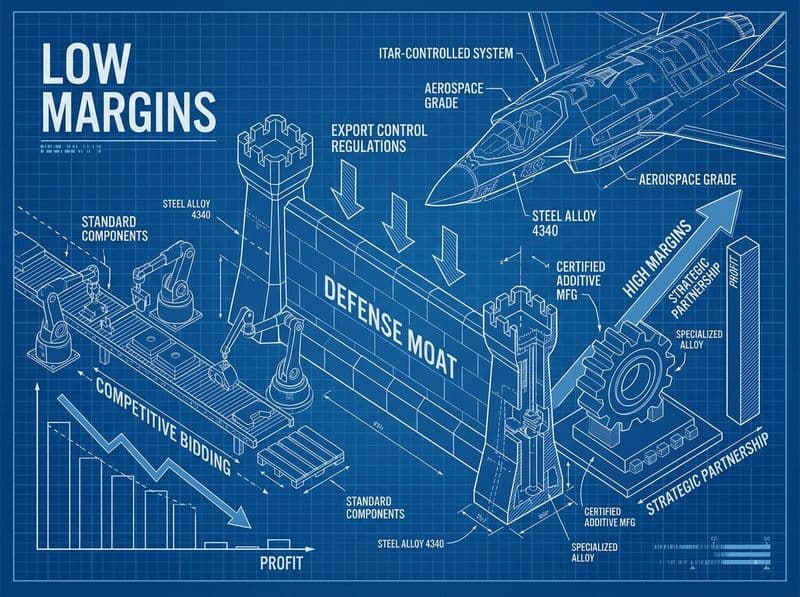
Where does the profit actually go when a physical product gets made? If you look at the traditional manufacturing value chain, almost all of the margin sits at the very beginning with the design engineers. A specialized engineering firm designs a proprietary bracket or mechanism, files the intellectual property, and licenses the technology or pays a contract shop to build it. They capture healthy margins because their technical skill is defensible and protected by law. But the moment you walk onto the factory floor where the metal actually gets cut, that margin completely collapses.
Manufacturing is an intensely CapEx-heavy business where you're constantly fighting for economies of scale. Ever since the Ford Production System, the entire game has been about squeezing out every last drop of unit cost. Over the last few decades, that pressure went global. If you run a CNC shop in Minnesota, you aren't just competing with the shop two towns over anymore. As international shipping costs dropped, you found yourself bidding against contract manufacturers in Shenzhen or Nanjing. When your competitor operates with fundamentally lower cost structures and receives state subsidies that Western governments simply don't match, winning commercial job shop work becomes a brutal race to zero. So how does a domestic machine shop actually make healthy margins today? Increasingly, the real margin comes from export control regulations rather than a clever technical trick or a new cutting tool.
Look at what happens when a part falls under ITAR or Western export control laws. A standard commercial shop might struggle to make thin margins on open-market aluminum brackets, but the moment a drawing is tagged for a defense application - like components for firearm silencers or aerospace systems - the entire market dynamic flips. Under ITAR, only certified domestic persons can even look at the CAD data or technical prints. Consequently, overseas manufacturers are completely locked out of the bidding pool. That creates genuine pricing power for companies like Hadrian and established defense suppliers, because they're suddenly competing in a restricted domestic market rather than against state-backed global capacity.
You can see the difference between these two worlds just by watching how shop owners behave. Commercial job shops are anxious, hunting for any small workflow efficiency that might protect their margins. Defense manufacturers, on the other hand, tend to keep things exactly as they are. When you have a steady, profitable position on an ITAR program, changing your process introduces risk and uncertainty. That reluctance to change makes complete sense - it signals a business that actually has pricing power and wants to protect what works.
The dual-use hurdle
So why doesn't every commercial machine shop immediately jump into defense work? Because clearing the regulatory hurdle is genuinely painful. Implementing compliance frameworks like NIST 800-171 and CMMC introduces massive administrative overhead, IT burdens, and strict labor constraints that can easily overwhelm a small facility. But in my experience, once a shop actually crosses that threshold, the economics shift completely. The marginal cost of taking on your second or tenth ITAR job drops dramatically, and the profitability makes the initial headache well worth it. That's why we're seeing a steady wave of commercial shops pushing to become dual-use manufacturers, running both open commercial work and high-margin defense jobs under one roof.
You could argue that using export controls to protect manufacturing margins is just artificial trade protectionism. In a sense, yes. But we have to be honest about the reality of global competition. In the US, federal and state laws actively restrict governments from picking favorites and subsidizing individual shops. Meanwhile, other countries routinely use direct state capital and market intervention to prop up their manufacturing base. Wanting a shop in Minnesota to compete on an even footing with a shop in California is healthy domestic competition. Forcing them to compete with state-subsidized overseas factories simply hollows out your domestic industrial base.
Export controls obviously exist to protect weapon systems and classified technology from falling into foreign hands, but they also serve as an essential economic lifeline for local manufacturing. Personally, I think we should take this logic a step further and introduce the concept of national priority manufacturing. Instead of forcing every critical domestic component through the suffocating compliance overhead of ITAR, governments could designate a tier of essential industrial parts that must be produced domestically. You'd protect local factory margins and secure critical supply chains without crushing small shops under unnecessary paperwork.