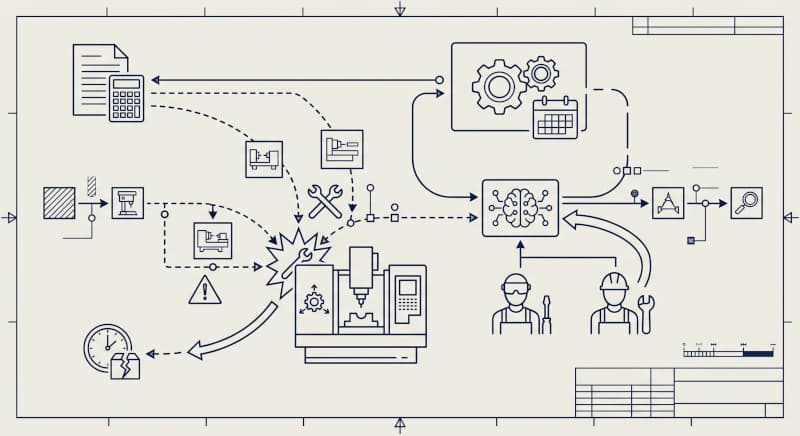
Western manufacturing is overwhelmingly high-mix, low-volume. Roughly 90% of the shops I spend time with operate on this model, which means they are making hundreds of completely different parts in tiny batches of one to a few dozen units. If you talk to almost any shop owner across the Western world, they'll tell you that quoting is their single biggest headache. They are spending hours manually working up price estimates for an order that might only be five or six parts, which eats away at their margins before a tool even touches stock. But I've come to the conclusion that quoting isn't actually the root problem—it's merely a symptom of a much deeper fracture on the shop floor.
What is a quote, strictly speaking? At its core, a quote is a manufacturer's promise: I will make this many of your part, at this price, and deliver it to your dock by this exact date. The delivery date piece is where the whole thing falls apart. You simply cannot generate an accurate delivery date in isolation without knowing what every machine, operator, and raw material order is doing at that exact moment.
The double-booking disaster
Imagine this scenario on a real shop floor. I was visiting an aerospace-certified machine shop in Minnesota recently that ran into this exact wall. They had two sales reps pursuing different customers who both needed an aluminum job run on the same high-end 5-axis CNC machine qualified to AS9100 standards. Rep A sent out a quote for a quick two-week job. At the same time, Rep B sent out a quote for a major project that would book that exact machine out solid for the next six months.
So what happens next? The six-month customer accepted and paid first, completely consuming the spindle capacity. A day later, the two-week customer came back and said they wanted to move ahead, unaware that the machine was gone. Because the shop was running fragmented quoting and scheduling tools that didn't talk to each other in real time, the front office accepted both orders. When they finally realized the machine was booked until next winter, they had to call the smaller customer back, cancel the order, and issue a refund. That customer walked away, trust was destroyed, and the shop killed an account they had hoped to nurture into a long-term contract.
Systems of record versus active agents
Now, you might ask: don't traditional ERPs like JobBOSS, ProShop, or Epicor already claim to connect quoting to the schedule? In theory, yes. In practice, traditional ERPs are passive systems of record where staff do the work manually and then spend twenty minutes telling the computer what they did. They give you blank data entry screens rather than automating the CAD geometry analysis or tracking parts as they physically move across the floor.
To actually fix this feedback loop, the software has to act as an active participant on the shop floor rather than an administrative database. For example, if you place iPads at each workstation and run computer vision models that visually recognize parts the second they come off a bed, operators don't have to spend time sorting through paper travelers or guessing part numbers. You get clean, instantaneous confirmation of where every job sits, which feeds live capacity directly back to the front office.
Conceding the buyer's perspective
There is, of course, a very fair counter-argument to dynamic, live-updating quotes. If you put yourself in the shoes of an engineering buyer or a procurement manager, you want a static number. You need a fixed price and a guaranteed delivery date that you can take to your finance manager, get approved up the chain, and rely upon without worrying that the lead time will slip six months while it sits in someone's inbox.
That tension is real, but pretending the shop floor exists in a vacuum doesn't protect the buyer—it just delays the bad news until their parts show up three weeks late. Reality always happens on a shop floor. When another customer books a machine or a critical spindle goes down, a dynamic system allows you to immediately see the conflict, reroute the job to an alternative machine, or communicate an honest updated lead time before the order is accepted under false pretenses.
Controlling the chaos
Machining is inherently messy. Tools wear out, setups take longer than anticipated, scrap happens, and raw material deliveries get delayed. People often ask me: how can any algorithm schedule dynamically when day-to-day operations are so chaotic? In practice, this is where the central limit theorem comes to your aid. Any mature shop already has a rich history of how long setups take and what scrap rates look like across different materials. You don't need six months of pristine data entry to make this work; getting workstations onto digital capture for just two or three weeks gives you enough live cycle data to calibrate the baseline parameters of your scheduler.
Today, the status quo in many facilities is that machine start times are off by 24 hours or more as a matter of routine. Claiming that shop-floor chaos is too unpredictable for automated scheduling is just an excuse to do nothing. By tying quoting, order management, and live floor execution into a single loop, you clear out work in progress faster, invoice earlier, and quote only what you know you can deliver.
For the past decade, Silicon Valley has told enterprise software founders to build point solutions that do only one narrow thing well. But in high-mix manufacturing, does a point solution just isolate the front office from the reality of the shop floor?
Can Western manufacturers truly automate their operations without unifying the entire value chain into one continuous system?